
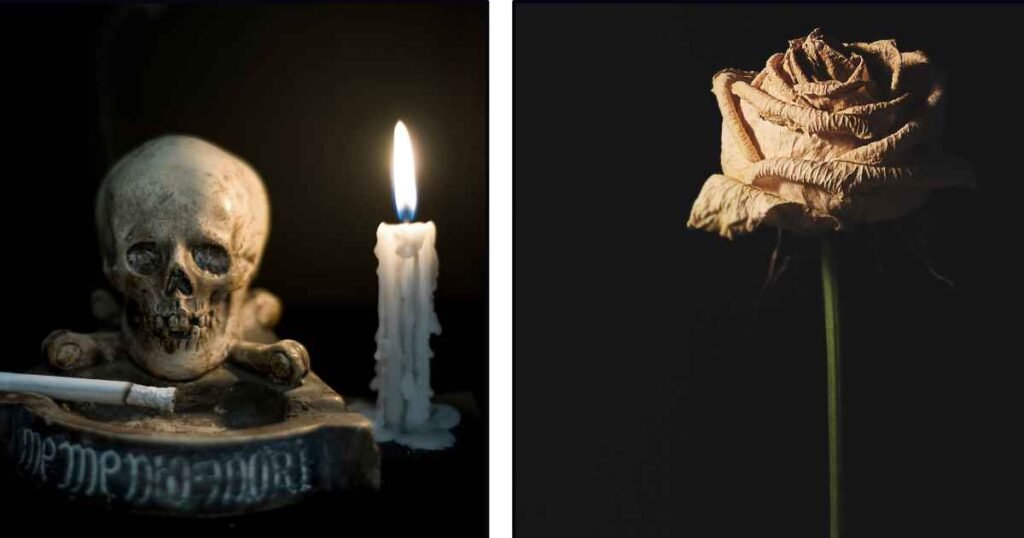
Memento mori is a Latin phrase. It means “remember you must die.” That sounds scary. But it’s not meant to scare you. It’s meant to wake you up.
A long time ago, Roman generals had a strange habit. After a big win, they would ride through the streets while crowds cheered. But behind each general stood a servant. That servant had one job. He would lean in and whisper, “Remember, you will die too.” It kept the general’s head from getting too big.
Monks in the Middle Ages did something similar. They kept a human skull on their desk. Not to be creepy. It reminded them that life doesn’t last forever. Painters back then did this too. They would paint a small hourglass or a dying flower into a portrait. It was a quiet message hidden in the art. Nothing lasts. Not even you.
This idea sounds heavy at first. But it wasn’t about fear. It was about paying attention.
Most of us don’t like to think about death. That makes sense. But the people who thought about it on purpose weren’t trying to feel sad. They were trying to fix a common problem. Time feels like it will never run out. Until one day, it does. And by then, a lot of days have already slipped by without us really noticing them.
A Man Who Started Calling His Mom
I have a friend named Marco. His dad died suddenly a year ago. He was only fifty eight. There was no warning. No hospital. Just a normal Tuesday that turned into the worst day of Marco’s life. Marco was thirty one at the time. He was busy with work, the kind of busy where every week blurs into the next.
He told me something surprising. The hardest part wasn’t just the sadness. It was realizing he had been treating time like it would never run out. Like there would always be more of it later.
After the funeral, Marco started calling his mom every single Sunday. It wasn’t because he suddenly loved her more. He always had. He just stopped assuming Sunday would keep showing up on its own. That one small change reshaped his whole year. It still does, even now.
A Grandmother Who Ate Dessert First
My grandmother did something that used to embarrass me at restaurants. She always ordered dessert before her meal. Every time. I finally asked her why. I expected a joke. Instead she said something that stuck with me for years.
“At my age, you stop trusting the meal to end the way you planned.”
She wasn’t being careless. She was just being honest. She had fewer years ahead of her than behind her, and she knew it. So she stopped waiting for the “right” order to enjoy her life. There’s something kind of joyful about that kind of honesty, once you really think about it.
Why This Isn’t a Sad Idea
People often think memento mori is dark or gloomy. Something you’d never bring up at a party. But it’s really the opposite of gloomy. Knowing that time is limited doesn’t make each day feel heavier.
It makes each day feel clearer.
A Sunday phone call. Dessert ordered first. A conversation you almost put off again.
None of these moments are huge or dramatic. That’s actually the whole point. Death isn’t really the lesson here. Attention is. Death is just really good at grabbing our attention, better than good intentions usually are on their own.
There’s also a hidden kind of comfort in this idea. If everything ends one day, then nothing has to be perfect right now. You don’t need the perfect career, the perfect year, or every relationship fully fixed before you’re allowed to feel okay.
Memento mori isn’t just telling you to hurry. It’s also gently telling you, this is already enough.
A Simple Habit, Not a Big Philosophy Lesson
You don’t need a skull on your desk. You don’t need a servant whispering in your ear after every small win. A few honest questions can do the same job, if you ask them often enough.
If today were an ordinary last day, what would I stop putting off?
Who would I call today if I stopped assuming there’s always a “later”?
What am I saving for some future version of my life that keeps getting pushed back?
You’re not supposed to answer these once and forget them. They work more like a daily habit. Kind of like checking your mirror before backing out of the driveway. A small check-in, done again and again.
A Story About Paying Attention, Not About Endings
Memento mori isn’t really about how short life is, even though that’s the part most people remember. It’s really about noticing that life is happening right now. On an ordinary Tuesday. While most of us are waiting for the “important” part of life to begin.
The people who actually live this way, like Marco and my grandmother, aren’t the most afraid of dying. They’re usually just the ones who got tired of sleepwalking through the only life they’ve got.
Maybe that’s the real lesson passed down from such an old idea. It’s not about fear. It’s not about rushing either. It’s about paying steady attention to the ordinary days that are already, quietly, happening around you.
FAQs About Memento Mori
What does memento mori mean?
Memento mori is a Latin phrase. It means “remember you must die”. It’s not meant to scare you. It’s a reminder that life doesn’t last forever, so it’s worth paying attention to the days you have right now.
Is memento mori a religious idea?
It shows up in many religions, but you don’t have to be religious to use it. Monks, philosophers, and even soldiers in ancient Rome practiced it in their own ways. At its core, it’s just a habit of remembering that time is limited, no matter what you believe.
Isn’t it depressing to think about death all the time?
Not really. The goal isn’t to feel sad or scared. It’s to feel clear. When you remember that time is limited, small moments start to matter more. A phone call, a walk, a meal with someone you love. It’s less about fear and more about not sleepwalking through your days.
How do I actually practice memento mori?
You don’t need anything special. Just ask yourself simple questions every so often. What would I stop putting off if today were an ordinary last day? Who would I call if I stopped assuming there’s always a later? Small, honest check-ins like these are the whole practice.